Three engineers. One year. A complete corporate travel platform.
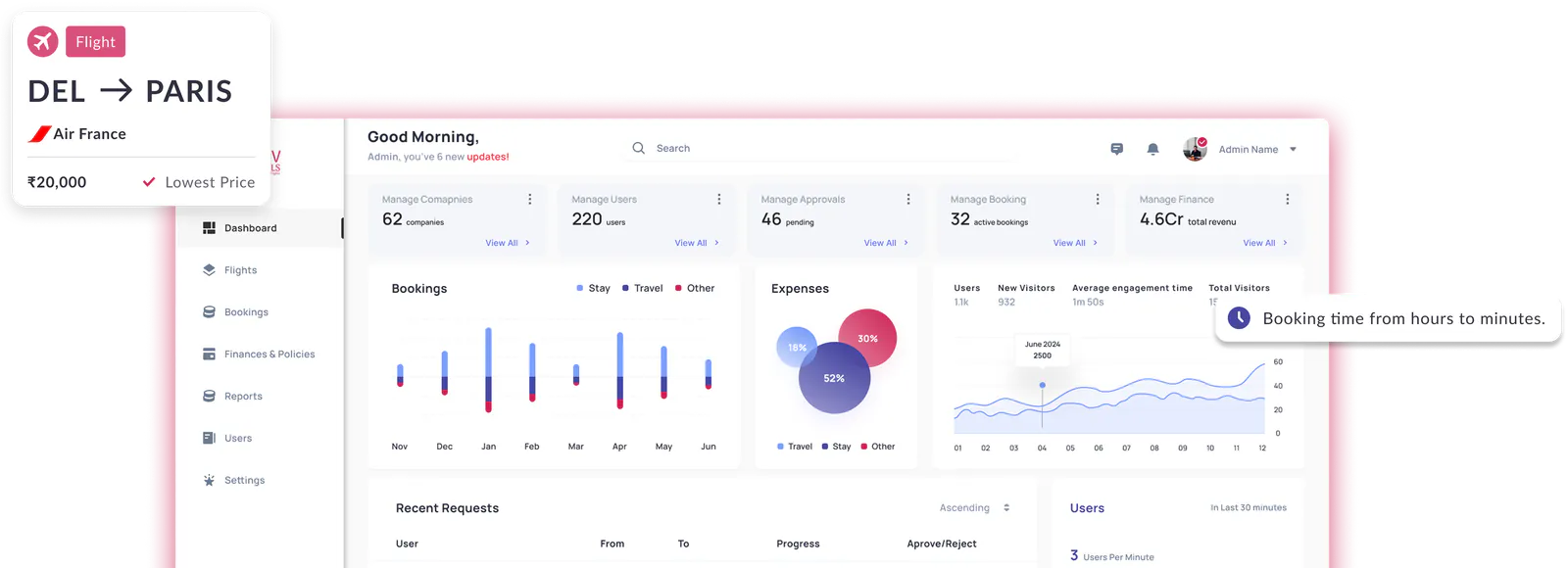
Reev Travels is a Bangalore-based travel company that manages flight and hotel bookings for corporate clients.
More people only meant more mistakes.
Every booking was handled over email, WhatsApp and phone calls, and tracked in spreadsheets. It worked while the business was small. As volumes grew to hundreds of bookings a month, adding more people to keep up only led to more mistakes. Reev had reached the point where it could only scale with a proper product.
Made the build-vs-buy call.
This was the hardest decision. There are plenty of travel booking tools on the market, and most suit a small agency. For a company with Reev's ambitions, they were limiting, and the upfront costs were high. The white-label platforms we spoke to either had poor design or lacked features Reev needed, especially reporting for both its own team and its clients, and support for multiple levels of users. My judgment was that if we bought, within a year the team would be running into the tool's limits and drifting back to spreadsheets. So we built.
Designed for many clients from the start.
I architected the platform as multi-tenant. Each corporate client is its own organisation, with separate users, wallet, invoices and billing terms, all run from one system. Four user types control who sees what: Reev's operations staff, each client's travel manager, employees who travel, and external guests.
Four user types control who sees what
Built a lean in-house team.
Instead of handing the project to an agency, I put together a small team: a backend engineer, a frontend engineer and a DevOps consultant, with a freelance QA tester brought in for regular testing. I led the project throughout. That kept costs low and kept the knowledge inside the business.
Built the whole back office, not just a booking screen.
The platform covers the full operation:
Booking
Flight and hotel search and booking (one-way, round-trip and multi-city), plus group booking requests and priced quotes for clients.
Offline bookings
Bookings made outside the portal can be recorded one at a time or in bulk, so nothing lives in spreadsheets anymore.
Spend controls
Approval workflows, booking limits for each employee, and credit terms for each client.
Billing
Prepaid and postpaid billing with a wallet ledger for every client, online payments through Razorpay, offline payment recording, invoices and vouchers sent by email or WhatsApp.
Reporting
A live dashboard showing bookings, revenue and margin. Sales, payment, turnover and pending-sales reports can be exported, and a full log records every change.